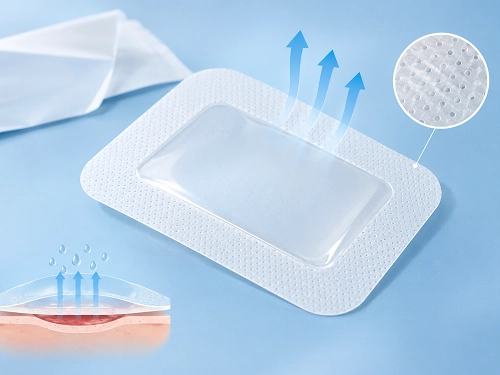
"Breathable" is the most used and least defined word in transparent dressing marketing. A breathable PU film dressing does not let the skin "breathe" air. It lets water vapor pass outward through a solid, pore-free film while liquid water and contaminants stay out. How much vapor passes depends on more than the film, and that is where buyers and clinicians most often get misled.
Key takeaways
- Breathability is a property of the whole laminate (film, adhesive and support layers), not of the film alone.
- A single MVTR number is meaningless without the test method, conditions, thickness and whether the film or the finished dressing was tested.
- More breathable is not always better. The goal is moist, not wet and not dry, and film cannot absorb fluid at all.
- Most real-world failures (pooling, lifted edges, skin injury) trace back to site choice, application and removal, not to the film's MVTR.
1. What "breathable" actually means
Polyurethane (PU) films used in dressings are typically polyether-based and have no holes. Water vapor dissolves into the hydrophilic segments of the polymer on the humid side (the skin), diffuses through, and evaporates on the dry side. Liquid water cannot cross because there are no open channels. Published polymer research shows that the choice of soft-segment chemistry strongly affects both water resistance and moisture permeability (Journal of Wuhan University of Technology, hydrophilic polyurethane study). That is why two clear films of similar thickness can behave very differently.
The rate is reported as moisture vapor transmission rate (MVTR), in grams of water per square meter per 24 hours. For a given material and test condition, a thinner film passes more vapor than a thicker one, because diffusion distance is shorter. FULUO's technical guide to PU film adhesive rolls describes film thicknesses of roughly 15–40 microns and breathable grades in the range of several hundred to over 1,000 g/m²/24 h by the ASTM E96 gravimetric method. Those are general industry ranges, not guaranteed product specifications, so always confirm against the current data sheet.
2. Why more breathable is not automatically better
Healing tissue does best when moist but not wet. A laboratory study in Scientific Reports tested polyurethane membranes with different permeability and found the best healing in a mouse wound model with a medium vapor transmission rate (about 2,000 g/m²/24 h). Very high rates risked drying the wound and low rates let fluid accumulate (Controlled water vapor transmission rate promotes wound-healing via wound re-epithelialization and contraction enhancement, Sci Rep 2016). This is a laboratory study of research membranes, not a clinical trial of commercial dressings, so treat it as a principle rather than a target to specify.
The practical consequence: a film's job is to manage vapor, not liquid. If a wound weeps more than the film can pass as vapor, fluid pools underneath no matter how breathable the film is. For those wounds, an absorbent dressing such as foam or hydrocolloid is the better primary choice, with film at most as an outer cover.
3. Breathability is a stack, not a film
A finished dressing is a laminate, and vapor must cross every layer. In series, the least permeable layer limits the whole. In principle, this means a highly breathable film can be held back by a thick, continuous adhesive coat or a low-permeability support layer, so finished-dressing performance can be lower than the film's own figure. This is engineering reasoning, not a universal rule, so ask for finished-laminate data.
| Layer | Role | How it affects breathability |
|---|---|---|
| PU film | Waterproof, transparent, flexible cover | Chemistry and thickness set the base vapor rate |
| Medical acrylic adhesive | Skin contact and wear time | Coat weight and coverage can limit vapor flow and set peel strength |
| PET support film | Keeps thin film flat during converting and placement | Removed or peeled at application, so it mainly affects handling |
| Release liner (plain, printed or S-cut) | Protects adhesive; enables one-handed placement | None once removed; affects application and branding |
Table 1. How each layer of a PU film dressing relates to vapor transmission. Layer structure follows FULUO's PU Film Adhesive Rolls page.
4. How to read an MVTR claim
Before comparing any two numbers, find out:
- Method. Cup methods such as ASTM E96 are common for materials. For permeable film dressings specifically, EN 13726-2 defines a dressing-specific test.
- Conditions. Temperature, humidity gradient and whether the dressing contacts vapor only or liquid water can change the result for the same product.
- Sample. Film only, or film plus adhesive (the finished laminate)?
- Thickness. A figure for a 15-micron film is not comparable to one for a 40-micron film.
5. Choosing by use case
- IV and catheter sites. Transparent film lets staff inspect the site without lifting the dressing. The CDC accepts either sterile gauze or a sterile transparent semipermeable dressing, says to change it if it is damp, loose or soiled, to use gauze if the site is bleeding, oozing or the patient is sweating heavily, and to change transparent dressings on short-term central venous sites at least every 7 days, with a pediatric exception (CDC summary of recommendations). Showering is acceptable if the catheter and connections are protected, but sites should not be submerged. See the cannula fixation dressing.
- Closed surgical incisions. Low exudate, and the clear film lets you watch the wound edge. Flexibility matters over joints.
- Shallow abrasions and minor burns. Film works as a protective cover when drainage is light. FULUO lists abrasions, lacerations and superficial and partial-thickness burns on its Transparent Film Dressing page.
- Showering and splash protection. See waterproof film dressing. Waterproof does not mean submersible.
- Secondary dressing. Film can hold gauze, hydrogels or alginates in place and add a waterproof layer.
6. Troubleshooting in practice
| What you see | Likely cause | What to do |
|---|---|---|
| Fluid pooling or white, soft skin under the film | Wound produces more fluid than vapor can escape | Change the dressing; consider an absorbent dressing |
| Lifting corners over elbows, knees or knuckles | Movement, wet or oily skin, or too small a margin | Dry skin fully, choose a larger size, apply without stretching |
| Wrinkles and trapped air | Placed too fast or stretched | Smooth from the center outward and press the edges |
| Redness lasting 30 minutes or more after removal | Possible adhesive-related skin injury | Stop that product on the area; see a clinician |
Table 2. Common problems with film dressings (general guidance, not medical advice).
Medical adhesive-related skin injury (MARSI) is widely described as under-recognized. The 2013 consensus panel's definition counts redness or other skin changes that persist 30 minutes or more after removal (reprint from the Journal of Wound Ostomy Continence Nursing; that publication was supported by a manufacturer grant, so read it with that in mind). Remove film slowly and at a low angle, supporting the skin, and use saline or adhesive remover if it resists. See FULUO's wound care dressing page for its dressing-change guidance.
7. For OEM and private-label buyers
FULUO's PU Film Adhesive Rolls are multilayer jumbo rolls built from transparent PU film, medical acrylic adhesive, PET support film, release liner and an optional insert strip for S-cut converting. Carrier options include standard, breathable and thin PU film, and customization covers slitting, grid or logo printing, roll width and length, and S-cut structure. Typical end products are IV catheter dressings, transparent wound dressings, post-operative dressings and tattoo aftercare patches. When requesting samples, put these questions in writing:
- Which MVTR test method and conditions, and is the figure for the film or the finished laminate?
- Film thickness and elongation, since these affect conformability on joints.
- Adhesive type and peel adhesion matched to the intended wear time and skin type.
- Liner design (plain, printed or S-cut for one-handed application).
- Biocompatibility and regulatory documents for your target market.
- Batch-level quality records, including how adhesive coat weight is monitored.
On the production side, FULUO's manufacturing page lists three production lines (sports tape, medical tape and wound dressings) and a 500 m² GMP 100,000-class workshop, and its quality control page describes two independent laboratories with full-time inspectors for microbiological, environmental and physical and chemical testing. The company's technical guide lists 180° peel testing, hydrostatic head testing for waterproofness, clarity assessment and thickness measurement as part of its roll QC. For finished dressings, standard transparent film dressings are listed in sizes from 6 × 7 cm up to 10 × 30 cm, and specifications and packaging can be customized through the OEM & customization service.
Frequently asked questions
Does a breathable PU film dressing let air in?
Not in the sense the word suggests. The film passes water vapor outward through the polymer while blocking liquid water and contaminants. It is not perforated.
Is a higher MVTR always better?
No. Too little vapor loss can let fluid build up, and too much can dry the wound surface. The right balance depends on how much the wound drains.
How long can a film dressing stay on?
It depends on the site and the product. FULUO's instructions say several days unless it becomes loose or soiled or signs of infection appear. Catheter dressings follow clinical protocols such as the CDC intervals above.
Can I use film on a heavily draining or infected wound?
Film does not absorb fluid and is generally not suited to heavy drainage. Use on infected wounds only if a healthcare provider directs it.